| This is a page for all those stories we could tell but only 51 blokes would appreciate. I would like contributions from any one who can put a few words together so feel free to send any stories but please keep it clean. Save the rougher stories for the reunion.
Here’s a few tales from the Orient that may jog some memories and cause a few smiles.
My name is Ginger Miles and I was posted to 51 at RAF Seletar to join the REME LAD, it was my first attachment to the RE’s and was to set the future scene with subsequent postings to 25 Engr Regt at Osnabruck and 35 Engr Regt at Hameln to follow. I had great times with all but somehow 51 was the one.
I was already Singapore blooded having been stationed at another unit on the other side of the island at Rowcroft Lines, but Seletar was something else, almost like a town within a city.
All these years later I remember some of the blokes like it was yesterday. Billy Eathorne of the rubber face, it was so sad to hear of his passing. Robbo, Pretty Bobby Booth, Jed Vickers, who was called Z Victor 1, after the TV police programme, Monty, Dippy, Keith, Bernie McFee Paddy, Pete Connor, Geoff Slack and all the others whose names escape me for the moment. Glad to see that most of you are still vertical. I was only 19 at the time, 65 now, so I was a bit wide eyed at all the adventures we had.
What about Kota Tinggi when Beaky the plant QMSI used to pay us in the NAAFI, then take his armband off and join the fun. Then delivering him home to Singapore in Monty’s land rover with the tyres squealing on the twisty bits down the Johore road.
One time I was rushing back from the airfield so as not to miss pay.
I was sat down with the first pint of Tiger on the go, when someone said, “ what’s that smoke”
I looked down into the car park and its my 3 tonner on fire with loads of fuel on board. A jerry can had gone over and dripped on the exhaust. One of the blokes had the presence of mind to very coolly grab an extinguisher and put it out, then it was straight back to the Tiger before it got warm.
Then there was the night down on the airfield, where things got a bit out of hand with the drink. I wonder if Bobby Booth still has the Dunlop Trak Grip scar on his leg!
The same night taking another bloke, (cant remember who it was), to the Royal Marines camp up the road and the Marines guard commander trying to lock him up, and a hell of a scrap starting up in the guardroom.
Then there was Marang.
I remember on the way up with the advance party we had a water trailer throw a wheel and it was left at a Malay Army camp.
We went back to fix it a few days later, and got it back as far as Kuantan. By that time it was getting late so we decided to kip there and carry on in the morning.
I left early with the 3 tonner and water trailer, and the Land Rover followed. We bowled along enjoying the scenery and the Landy overtook. I realised at that point that there was a bloke missing. I hooted and flashed the lights, but they waved and carried on. I had no fuel to get back to Kuantan so had to press on to Marang.
Then I had to go back and get a very pissed off bloke.
He had gone for a slash, when he got back we were gone. Each of the vehicles thought he was in the other one
Oh for a mobile phone.
Shortly after that I borrowed Paddy’s motorbike to go for a wash down at the beach, and on the way back came face to face with a 3 tonner on the access road and had to abandon ship.
I was only wearing flip-flops and shorts so gravel rash was extensive. So that was me, off the job and back to Seletar.
That’s it for now …
more later perhaps…..
Regards to all…… Ginger Miles
1966 and all that (Or how I finally became slightly interested in Football)
Now I have never been much of a football Fan. I never could understand the need to talk about the missed goal or might-have-been penalty for hours on end.
I did not connect with the lads who wore scarves in the local team colours. Many a decent conversation about the secrets of the universe or some such intellectual discussion was ruined when some idiot said, “What about that Goal last Night” and the search for the answer to creation would be gone forever.
I swear that the human race would have progressed way beyond the need to fight wars if they didn’t spend so much time talking about football.
For instance I never rated George Best as anything more than a reasonable player and I saw many other footballers score equally brilliant goals that no one seemed to comment on, but Gorge was talked about and venerated like a God.
The adoration and fans buying him drinks would cause the death of the poor fellow. The only time I met George was on a landing at HMP Pentonville. I walked past him and found other officers asking him for his autograph. Poor man didn't even get a break from it while he was in prison.
When I saw him in interviews later in his life he seemed bewildered that the drink had caused him such a problem.
All the hype and hot air resulting from things like that and other stories left me totally uninterested in the game of football.
So in 1966 when England was in the Final of the World Cup I had almost no interest at all. More especially as we were in Singapore, seven thousand miles away from the main action.
I went to bed at a reasonable time as payday was a few days away and I did not have enough for the Malcolm or NAAFI clubs. No thought of Football on my mind.
Now at that time we didn’t have computers, mobile phones etc but we did have radio and TV. Important events could not be transmitted To TV over great distances because we did not yet have the orbiting communication satellites. We did have transistor Radios but you needed a radio with a bit of Power to pick up a decent Live world Service Broadcast. The problem was, the only place to get the best reception of the world Cup was by using the plug socket at the side of my bed. Or that’s what everyone said.
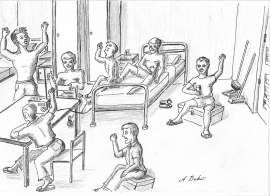
Now the army is a strange place where you get used to sleeping through all sorts of noise and people using your bed as a park bench while they spoke to the lad in the next bed, or played cards etc. Usually I slept through everything with no problem but this time it was different because this was a crowd of lads who were full of beer and all worked up in anticipation of the coming match.
Nevertheless I still attempted to sleep. My problem began when I found my self half listening to the commentary and slowly coming awake I was drawn in. The man was saying that England was winning although there seemed to be a bit of a dispute about the score and apparently the Germans were a bit irate.
England winning? It just wasn’t possible. We never won anything except Wars. The World Cup, the Rugby or the Ashes were usually quite beyond us.
Now I was wide awake and holding my breath until the words “ They think its all over, Well it is now” With that the room erupted and we were all cheering and the whole block was joining in. we could also hear the distant cheers from the RAF blocks across the square. We celebrated as people brought out stored beer and spirits and shared it round.
From all this you probably assumed that I was then converted to the ranks of football supporter.
Sad to say by the end of that week I was so fed up with hearing about England’s win I was put off football again.
My only interest was a vague perusal of the league table to see how Wolves and Villa had got on.
The purpose of this missive is mainly to recall how the magic of Radio for a moment joined us to our English roots so far away and made even a bloke like me become a fan for just a moment in time.
Alan (Beef) BakerA story about Barry Duckhouse
Now as story telling material, Barry was a gold mine. I could fill a book but in respect for people still living it is perhaps better that I don’t.
However this is the one that always comes to mind whenever I think of him. As with all good stories different versions may be told but the essentials are the same.
Barry (or Brummie as he was mostly known) was duty Regimental driver at Waterbeach Camp. The duty meant that he would be on call for general transport duties and be on call for the Duty Officer
At about 1900 hrs after the Guard had paraded and everyone was settling in to the normal routine Brum approached the Orderly officer.
“Sir can you sign my work sheet so that I can pick up my wife from the railway station”
The young lieutenant saw no harm in that as it was only about half an hours drive away. So he signed it with a smile and thought nothing more of it.
About 2300 hrs everyone noticed that Brum was still not back. Another driver was found to drive the route and check on Brum’s local address but there was no sign of him or the duty Landrover he was driving.
The next day he was still missing and it was all a mystery as the police were informed.
The very next day Brum drove through Waterbeach gates and parked up. He said “I’m back and I will just put the Landrover back in MT.” As though nothing was amiss.
The RP Staff were flabbergasted and immediately bundled him into the guardroom and put him in a cell pending investigation and he was eventually put on a charge.
The CO asked him why he had been absent. Brum replied, “ I picked my wife up from the station and dropped her off at home”. Then he added “ I had permission and the Duty Officer signed my work sheet”.
“Well” said the CO, “That should have only taken you about an hour or so to pick her up from Cambridge station”.
“No sir it was Walsall station and I stopped at me brothers house for the night before coming back”
The CO while trying to hold back the laughter sentenced him to 28 days in the Guardroom.
As with all the stories about Barry they don’t just end there.
While doing his time in the guardroom he was put into the exercise yard, which had, walls around 14 feet high with razor wire on the top. He had run out of tobacco and no one would give him a cigarette or a smoke.
There was a window looking out on to the exercise yard. Brum used this to give himself a boost and flipped himself over the wall and the wire on to the flat roof. of the Guardroom. scrambling over the roof and dropping off down the other side. He then went down to the local pub and got a mate to give him some fags and a beer. Which took about an hour all told.
As it was quite a mild day the RP staff had not thought to check on him in the yard and were just thankful he wasn’t being his usual entertaining self and leading them a merry dance. (He loved winding the RP Staff up)
Imagined the RP Sergeants consternation when Brum tapped on the window and said, “You can let me in now I have had my fag and a pint”
Barry was the only man I have ever known who could run up a 10-foot wall and get over without assistance.
I will miss him and will always remember him fondly. Rest in peace Mate.
By Alan Baker June 2012
---------------------------------------------------------
Allen (Monty) Mountford(illustrations by Alan (Beef ) Baker)
---------------------------------------------------------
Road to China Rock By Alan Baker China rock was the place where we had the job of relocating the observation Tower used for spotting Artillery and bomb hits on a little rock that rose from the sea about a mile off shore in the China Sea. The original site was being eroded by the sea and needed a safer base. There was a dirt track road that led up the coast to the Tented Artillery camp where various units would take their turn at pulverising that little rock in the China Sea. This dirt track was in a very poor condition and was also used by locals and the Bauxite mine personnel. It was particularly bad after a Monsoon. As we were working in the area it soon became one of our projects to sort out the road with our plant equipment. Construction troop members got the usual chunky jobs of cleaning ditches etc but there was one part that needed a bridge making, There was a small tidal river that could be driven across at low tide or crossed on foot by a rickety old wooden bridge at high tide. We had a very young 2Lt with us at the time and he drew up the plans for a bridge with concrete abutments with RSJ spans topped off with a concrete slab. It was a workable option but difficult to dig out suitable foundations in the mud without a lot of plant equipment to build some sort of cofferdam. So our leader decided we would build on top of the mud with very little preparation to save time. We needed abutments of 10 ft wide for the road way and about 30 foot back into the rocky bank to give a viable bridge. This also had to be sunk into the mud deep enough that it would not sink under it own weight and had to rise from the water at least 5 foot at high tide. In all both abutments needed a few tons of concrete. The abutments also had Armco pipe built in to ease the wear and tear of the tides. Our leader went off to the local merchant for timber to build the shuttering for the abutments. He returned some time later with quarter inch ply board and 2X2 timber to build the shuttering with. Most of us by this time had a fair amount of experience with concrete projects and expressed our doubts about the flimsy materials. We were assured by our leader that he had done the calculations, and all would be well. The shuttering was duly constructed and we began mixing and pouring the concrete. When we had a depth of about 3 feet the shuttering gave up and burst. The only saving grace was that we had a much better base to build the new stronger shuttering on. From then on the job proceeded nicely and at the end only Geoff Mynette and myself were left to do a bit of plastering and rendering to the outsides of the finished bridge to give it a more professional look. The only problem we had was sand flies and poisonous water snakes swimming around the bridge. We had been told by one of the RAF medics that the bite from these snakes would likely kill you unless you got treated very quickly after being bitten. Not a nice thought as we were on our own and had no radio contact with the people working up the road. We were wearing shorts and the sand flies left no inch of exposed skin untouched. Our legs and arms in particular were a mass of tiny septic sand fly bite that itched like mad. Geoff Mynette was suffering really badly and was nearly cracking up. To do the rendering on the outside of the bridge span I was using the angled wooden shuttering as scaffolding. This consisted of a beam fastened under the span with upright rakers to hold the vertical boarding in place. Once the vertical shuttering was removed the rakers were pushed down and made a fairly safe platform when a plank was put across. I was at the mid point and above the deepest part of the river and enjoying the respite from the sand flies, as they seemed to prefer the bank side. Geoff by this time was sat on the bank rubbing furiously at the bites on his leg and almost in tears at the irritation of it all. I chose this time to lean back and admire my work and promptly overbalanced. Arms wildly grabbing at thin air with my steel float luckily landing safely on the bridge I fell in almost slow-motion into the drink. As the water closed over my head the thought of the sea snake hit me. I surfaced and some one screamed with an awful high-pitched wail and I realised it was me doing the screaming. I have never been much of a swimmer but I reckon that that day I could have beaten any Olympic champion as I ploughed to the bank. The upside to this was the change in Geoff. Instead of being hysterical with the itching of the sand fly bites he was now holding his sides with hysterical laughter. When he could get his breath he explained that he had watched me hit the water and bob back up heading for the bank like captain Hook being chased by the crocodile. This triggered a reaction from me and neither of us stopped laughing for ages. Of course the story got better with the telling over a few drinks in the bungalow that night as we got pleasantly drunk with calamine lotion soothing our sand fly bites. Its all a long time ago now but I can still remember the fear as I hit that water. I never liked snakes before and that did nothing to make me change my mind.
_________________________________-
Labuan By Alan Baker
Labouan is a small Island off the coast of Borneo and in the early part of 1966 we were sent there from Singapore to build a large concrete area for the RAF to park their refuelling bowser lorries on. We travelled up in an Argosy aircraft that you could see daylight round the door seals and after the heat of Singapore we were all half frozen when we got to the higher altitude.
Some of the work we carried out there suffered from the lack of layout plans of the camp area. What plans we had were old and out of date. There had been years of hole digging and laying signal cables etc so no one really knew what was underground.
One of the jobs was to lay cable and pipes across the main perimeter road which was also the road to the main gate of the camp. As it was a busy road we had to close it off and carry out the work at night. This time we were assured that the plans of the road showed that there were no hidden obstacles to cause us any problems. We had been assured that the plans we had were the most up-to-date available. The road was closed at about 10 pm and proceeded to dig our trench across the road.
The trench was about 5 feet deep and good progress was made and by about 1 am we were at the centre of the road which, as it was a pick and shovel job was quite good. At that point Taff Fisher uncovered a pipe. He shouted up to the staff Sgt, Taff Jones, to tell him what he had discovered.
With some irritation Jones said to break it out because there was nothing of importance shown on the drawings and he was impatient to get back to his bed. Taff was still loath to carry on and asked again If he should dig round it rather than break through.
More irritation from the S/Sgt, So Taff, carried on.
The pick swung down and the sound of metal on metal was heard. "Staff this is a metal pipe and its going to be hard breaking it out". “Just get on with it” was the only comment.
More metal on metal noises then a comment from Taff that there appeared to be water coming from the pipe.
"It will be ground water", said Jones, “just keep hitting it”. Taff did as he was told and suddenly the water was spouting above the trench and Taff was scrambling out.
We had of course hit the water main that carried the camp and airfields water supply.
The next day we had the scruffiest RAF personnel in the Far East because there was no water to wash with. Breakfast was delayed until emergency water supplies were brought in and our name would have been mud if it weren’t for the fact there was no water to make mud with.
This was not the only time we suffered the consequences of inadequate plans and drawings. We also managed to take out the communications to the control tower and Signals Unit after being told that the area we were digging was virgin ground. The area turned out to have all the signal cables for Airfield under it.
Once again it was the result of poor record keeping by the MPBW. It was after all their responsibility for the camp infrastructure. Most of them were Civilians from the UK who spent their time knocking back pink Gins in the Mess leaving the donkey work to Local Workers. ( I am sure that some of them were highly qualified and hard working, its just that I never met them.)
Despite all of our problems the main tasks were completed in good time by working flat out for 12 hrs a day. Although we did still find time to have some very entertaining parties.
-----------------------------------
Darts with the Signals section By Alan Baker
A monumental Darts tournament with the Royal Signal section is a very strong memory. Tiger beer was flowing freely and curry and sandwiches were laid on as a buffet.
The curry was a very hot one and I at that time did not like curry very much. So after trying a little I had to discard it and grabbed sandwiches instead. To my amazement someone fed the curry to a stray dog that had been adopted by some one. The dog wolfed it down with no apparent harm. I don’t know why but I had assumed that dogs would dislike curry as much as I did.
I won my match against the Signals bloke I was playing against.He said, because he had lost it was their tradition that he buy the beers. The only problem was he brought two beers. Then we won the match overall and this bloke turned up with two more beers. I was already past my limit but honour dictated that I did not abuse his hospitality so I had to drink them.
I woke next morning wrapped in my mosquito net on the floor by the side of my bed. During the night my arm and face must have been outside of the net and the mosquitoes had made a meal of it. I went to work that morning with itchy bumps and an eye like I had been in a fist fight and the hangover from Hell.
I would like to say that it taught me a lesson but sadly it didn’t. I had my twenty-first birthday in Labuan. It fell on a day when my money had trickled to a sad pittance. So when every one went to the Malcolm club I waited a while so that there would be a shorter drinking time.
When I arrived there, people on hearing it was my birthday started to by me drinks. Yes, you have guessed it, I ended up on the floor covered in bites again with another hangover. This time it did slow me down. I did not drink more than a pint tops for some months until going out with Geordie Aston and Frank Hughes one night in Bugis Street. That's another story altogether though.
|
| Visitor Counter: | |||||||
 |  |  |  | | | ||